
What Is a Defensible Dispute Decision? Documentation Standards for Issuer-Side Teams
Jun 04, 2026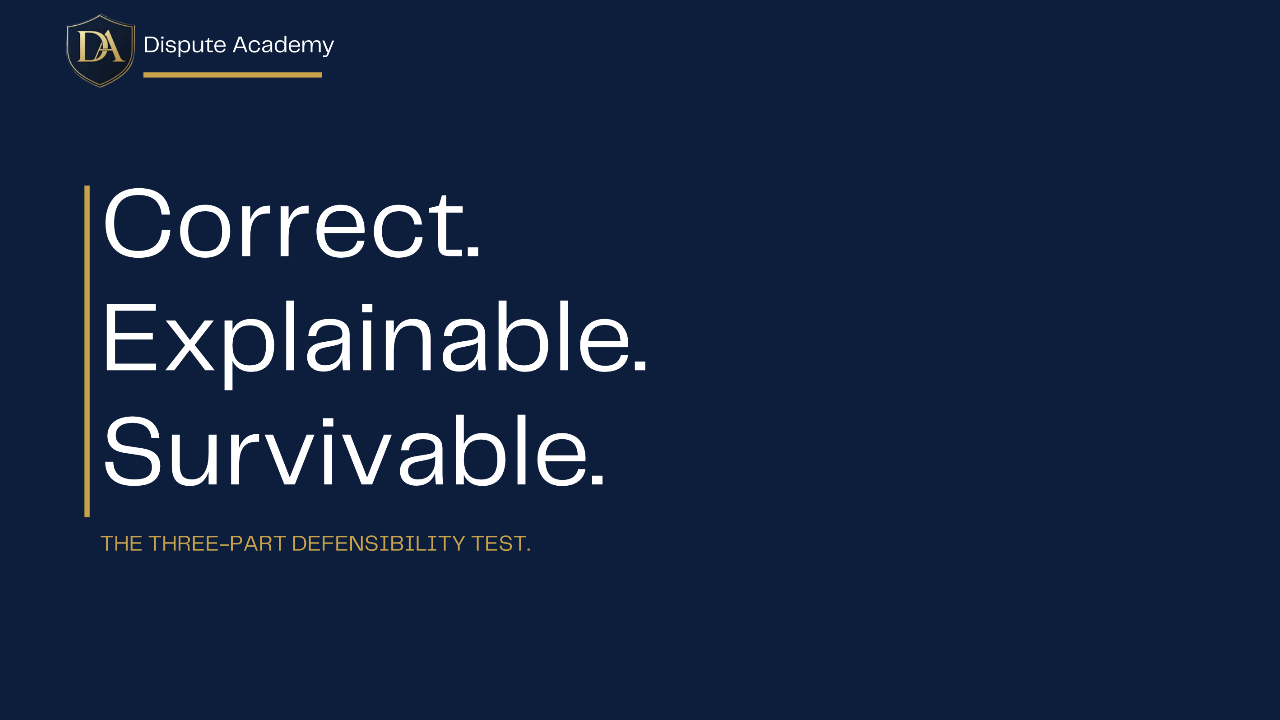
Most dispute programs measure themselves on outcomes: how many cases closed, how quickly, with what financial impact. Those metrics matter operationally, but they are not the standard the program is actually held to. The standard is defensibility - whether each decision, taken individually, can be reconstructed and defended weeks or months after it was made, by someone who was not in the room when it was decided.
This article lays out what defensibility means as an operational discipline, the three-part test mature programs apply, the documentation standards that make decisions hold up, and why the work has to happen at decision time, not after.
Scope note: This is not legal advice. Defensibility here describes the operational discipline of producing decisions that survive internal QA, leadership review, and external scrutiny. Your institution's policies, tooling, and documentation requirements vary. The goal is decisions that hold up the moment someone pulls the file.
Why defensibility fails
The first failure mode is treating documentation as a record of what was decided rather than a record of how. A note that reads "credit issued, fraud confirmed" captures the outcome but says nothing about why the analyst reached it. Six weeks later, when QA, leadership, or an external reviewer pulls the case, the decision is unrecoverable. There is no way to tell whether it was correct, lucky, or wrong, and a decision that cannot be reconstructed is, by definition, undefendable.
The second failure mode is documenting the customer's claim instead of the analyst's reasoning. Notes that summarize the customer's story - "customer says they did not authorize the transaction" - are not investigation notes. They are intake notes. The investigation is the work the analyst did between the claim and the decision, and that work is exactly what disappears from most case files. What evidence was reviewed, what alternatives were considered, what tipped the call - none of it survives.
The third failure mode is letting documentation lag behind the decision. When notes get written hours or days later, they reconstruct the decision rather than capture it. Reconstruction is selective. Analysts remember the evidence that supported their conclusion and forget the evidence they weighed against it. The note becomes a defense of the outcome rather than a record of the reasoning, and defensibility erodes precisely where it is supposed to hold.
The three-part defensibility test
A decision is defensible when it passes three tests, in this order.
Correct. The classification, the evidence, and the disposition align. The decision is the one the facts support, not the one the dropdown defaults to, not the one the customer wanted, not the one that closes the case fastest. Correctness is the floor. Without it, nothing downstream matters, because a well-documented wrong decision is still a wrong decision.
Explainable. A reviewer who was not part of the decision can reconstruct the analyst's reasoning from the case file alone. They can see the classification rationale, the evidence considered, the alternatives weighed, and the bridge between the evidence and the disposition. Explainability is what separates a decision from a verdict - a verdict announces the outcome, a decision shows the work.
Survivable. The decision holds up when someone with adversarial intent (an auditor, an internal reviewer, a complaint escalation, an external examiner) pulls the file months later and tests it against the standards that applied at the time. Survivability is the test the program is actually held to, even when no one is currently testing it.
A decision that is correct but unexplainable is operationally indistinguishable from a guess that happened to land right. A decision that is explainable but incorrect signals a process that documents itself well but reasons poorly. Both failure modes show up in mature QA programs, and both are addressable, but only if the program separates the three tests rather than collapsing them into "did we close the case."
Where AI struggles
The defensibility test is also where AI tooling currently falls short, including for the cases automation handles well on the surface. Models can produce summaries that read like investigation notes- fluent, complete, structured. What they cannot reliably produce is the reasoning bridge: why this evidence supported this disposition and not the plausible alternative. The output looks defensible until a reviewer probes it, at which point the absence of an actual reasoning chain becomes visible.
This matters operationally because programs that use AI to generate case notes inherit AI's documentation pattern at scale. The notes look uniform and complete, which improves surface QA scores. The reasoning underneath them is thin, which fails the survivability test the moment a case gets pulled. Strong programs use AI to support documentation (structuring it, surfacing missing fields, flagging inconsistencies) and keep the reasoning step as a deliberate human act.
The discipline of writing at decision time
The single most underrated operational discipline in defensibility is writing the reasoning at the moment the decision is made, not after.
Decision-time documentation captures what the analyst actually weighed. Post-hoc documentation captures what they remember weighing, which is a different and less reliable record. The gap between the two is where unexplainable decisions get manufactured by analysts who believe they are documenting their reasoning when they are reconstructing it.
That discipline has to be built into the workflow, reinforced through QA against the three-part test, and trained until it becomes the default. Without it, analysts default to outcome notes, AI tooling defaults to fluent summaries, and the program accumulates decisions that look closed but cannot be defended.
What defensible documentation looks like in practice
A mature defensibility standard produces three operational outcomes.
Reasoning is visible without explanation. A reviewer pulling the case three months later can answer "why was this decided this way" from the file alone, without speaking to the analyst who decided it. The reasoning lives in the file, not in the analyst's head.
Alternatives considered are recorded. The case file shows not just what was decided but what else was considered and why it was rejected. This is the single most underbuilt documentation habit in dispute operations and the one that most directly produces survivability.
Consistency holds across analysts. Two analysts presented with the same fact pattern produce documentation that reaches the same disposition through comparable reasoning. Documentation consistency is the operational signal QA programs and external reviewers look for first - variance at this layer is what gets programs flagged.
These outcomes do not emerge from a documentation template. They are the product of decision-time discipline, QA calibrated to the three-part test, and a program design that treats documentation as the work, not the artifact left over after the work.
Why this matters
Closure is a metric. Defensibility is the standard. And the standard is tested not when the case closes, but at every later moment a reviewer pulls it - months after the analyst who decided it has moved on, in a context that did not exist when the decision was made. A dispute program is the sum of decisions it can defend at that moment, not the sum of cases it has closed.
Written by Haykanush Shahbazyan, founder of Dispute Academy and a fintech dispute operations leader with more than a decade of experience building issuer-side programs.
Stay connected with news and updates!
Join our mailing list to receive the latest news and updates from our team.
Don't worry, your information will not be shared.
We hate SPAM. We will never sell your information, for any reason.